
Around A.D. 230, a Christian church was built on the grounds of a large Roman legion camp near the ancient city mound of Megiddo. If you have never heard of this discovery, here are a few short videos to get you up to speed (None of these is any kind of endorsement of its content sponsors!):
As an Orthodox Christian, I can tell you with great confidence that this worship space is the direct pre-cursor of any modern Eastern or Oriental Orthodox church. Any depiction or conception that looks like this cartoon dining room is way off the mark:
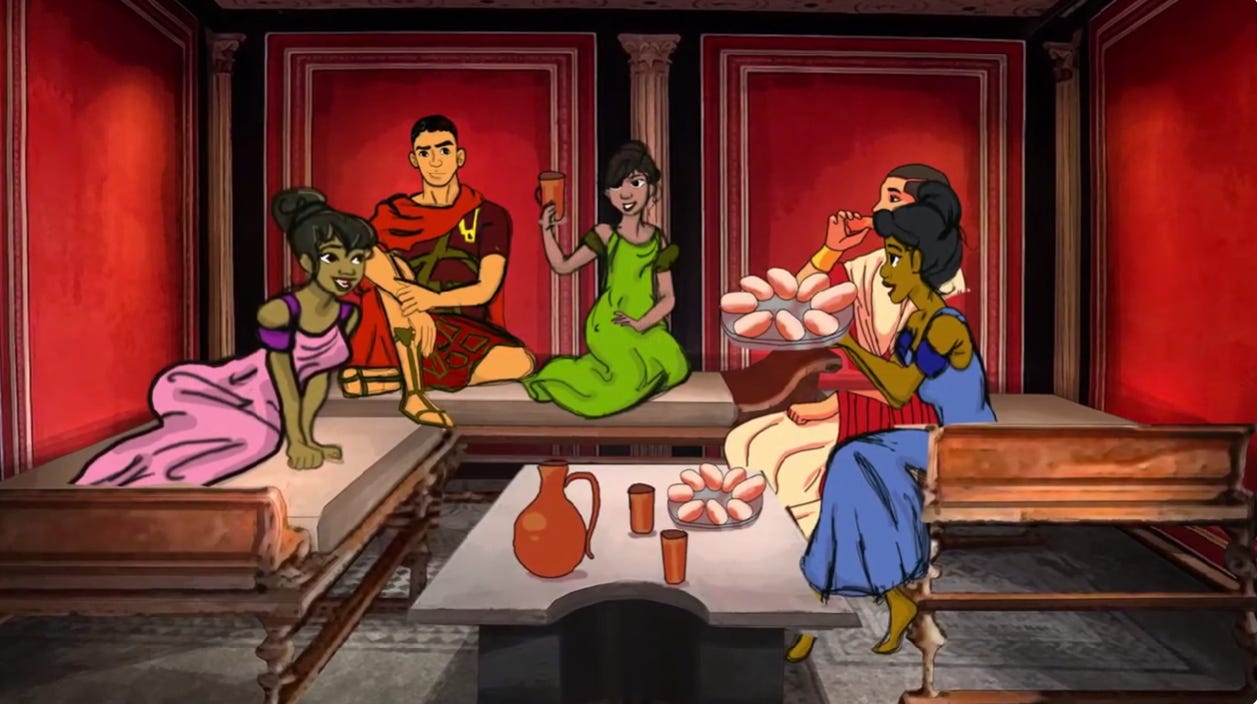
First of all, these cartoon people are giants relative to the size of the room. The room itself is 16 x 32 feet. The table in the middle of the room is not a kitchen island for serving buffet style during a Christian “love feast”. There would have been no other furniture in the room. Instead, like most modern Orthodox churches, the worshipers would have been standing. Pews in an Orthodox church are a recent innovation, mostly in the United States.
For further discussion, I will use this beautiful black and white rendering of the Megiddo Mosaic floor done by artist, Kelly Vanderbeek. Kelly has kindly given me permission to use her art in this post. Please check out her site (Legacy of Megiddo) and browse her merch.
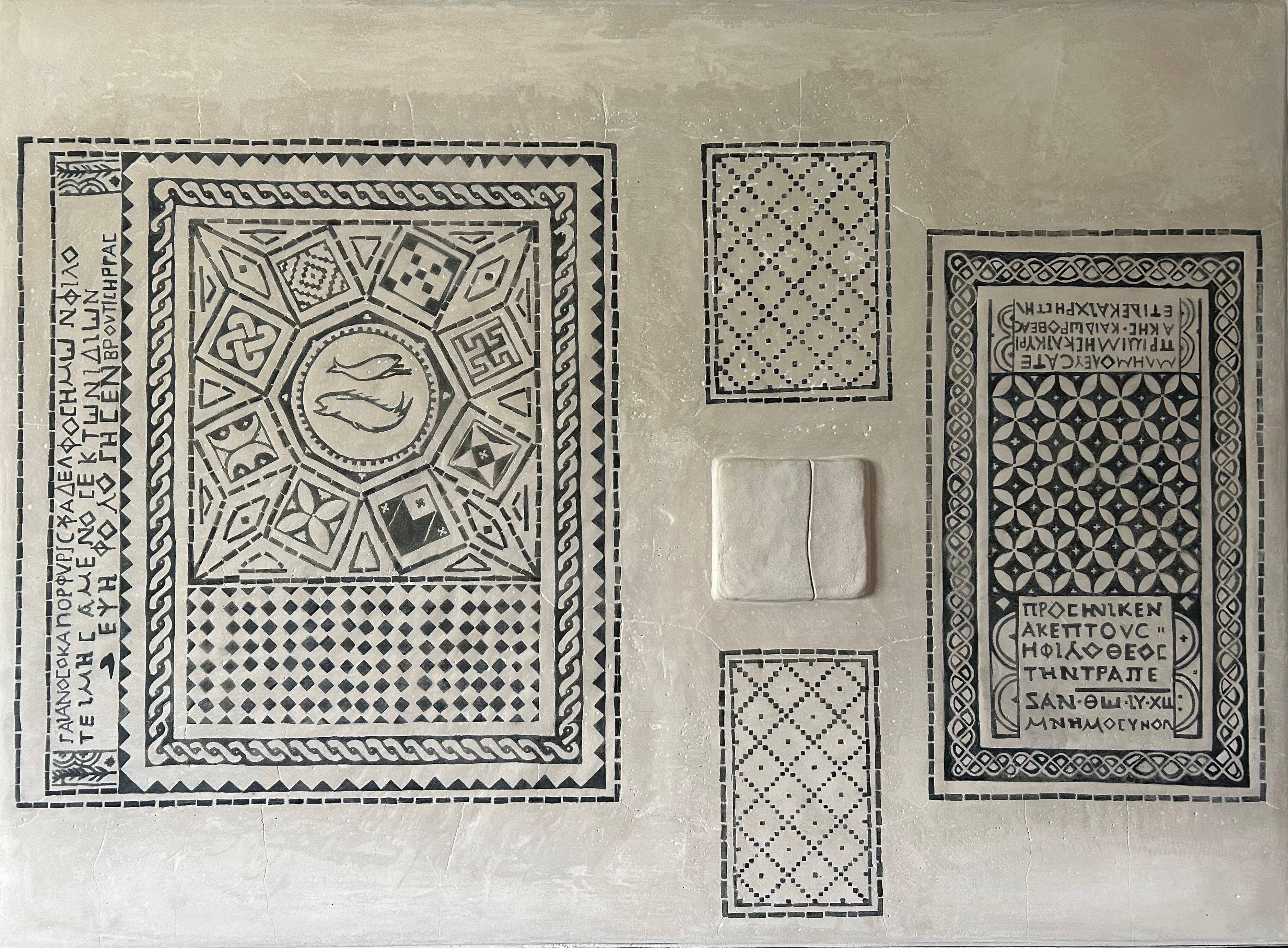

Thanks to reader feedback, I have added directional indicators to a second version of the church floor. The ancient Christian (and Jewish, too) orientation was toward the East, literally the Orient.
Church Capacity
This room was 512 ft2. If we subtract ~100 ft2 around the alter table (where the priest would have presided over the orderly liturgy of St. James), we are left with about 400 ft2 for gathered worshippers. So how many Christians would have fit in here? You need to set aside any American conceptions of personal space. A good reference is a small Russian Orthodox church where a comfortable metric is 10 ft2 per worshipper, and 5 ft2 when packed in. So between 40 and 80 people could have been worshipping in this space during any given service.
Separation of the Sexes
Now let’s talk about men and women. Just like in the modern Orthodox Church (particularly in monastic churches), men stood on one side and women on the other. How can I be so confident of that practice in the Megiddo church? Because the inscription on the left (North) side of the tile floor mentions exclusively men’s names and the inscriptions on the right (South) side of the floor mention exclusively women’s names. I’ve seen nobody else make this observation. Ah, but you say, in the Orthodox church today, men stand on the right and women on the left. But in ancient times we know it was the opposite. In fact, to this day the Coptic Orthodox church maintains the separation with men on the left and women on the right.
Proportion and Placement
Why is the men’s side bigger than the women’s side? That is simple. It is on a military base which would have had a predominantly male population.
Why is the altar table in the middle of the church? Just like churches do today, they work with the space that they were allotted. The worship would have been oriented to the East, but in this case, the entrance afforded to them was in the East wall (SE corner), so it would not have worked well to have the altar up close to the East wall. There was no apse. The priest needs to be able to compass the altar at several points in the liturgy, so given this small footprint, situating the altar in the middle made most sense.
Alternative Name

This next one shocks me, frankly, and betrays just how ignorant most people who write about this archaeological find are about Eastern Orthodoxy (or Roman Catholicism for that matter). The brother who paid for the costly mosaic floor didn’t have a “nickname” Porphyrios. Porphyrios is not the Greek equivalent of the Latin Gaianos. Nor is this an alias situation (e.g., Saul/Paul). The man had a baptism name, just like every Orthodox Christian gets today if they have converted from something else. The inscription reads: “Gaianos, who is also called Porphyry, a centurion, our brother, having earnestly desired to do so, has commissioned this mosaic-inscription. Brutus has done the work.” Gaianos was undoubtedly a pagan convert who took the Christian name Porphyry. Porphyry (a.k.a., Porphyrios) is the name of a famous Orthodox saint who was born shortly after the Megiddo church was built. That St. Porphyrios (of Gaza, by the way, whose church stood for over a mellenium and was bombed in 2023) could have been named after the same martyr that our guy Gaianos was named after. Perhaps both men were baptized in honor of a common martyr from an earlier period of persecution.
Learners’ Corner
Now, what is with the checkered area on the West end of the men’s side of the floor? Was the mosaic artist not clever enough to design a geometric space to cover the whole rectangle? Could he only work in proportional squares? I find that hard to believe. The artist clearly had talent. So what is up with the seemingly wasted checkerboard space? I submit that this space was for catechumens. In a church without a narthex, catechumens would nerveless be relegated to the back row. Those who were already baptized and chrismated into the Church/body of the God Jesus, stood in the front of the nave. The church already had a well established, structured catechumenate by the 3rd century, and one typically spent anywhere from 1 to 3 years preparing for entry into the body of the faithful, where they could participate in the mysteries of the Church, especially the eucharist. By the way, this understanding that this area was the “back” of the room is a proof point for the idea that the worshippers faced East, a practice universal in East and West Roman empires in the first millennium.
Warrior Saints
The fact that this church was built and paid for by a Roman Centurion comes as no surprise to the Orthodox. Our hagiography is chock full of famous martyrs and confessors from all ranks for the Roman army. The 40 martyrs of Sebaste, St. George, St. Maurice, St. Dimitrios and many others were all around this time of the Megiddo Church. The location inside a Roman military compound near Megiddo Prison strongly implies imperial toleration at least at the local level. It may have served Christian soldiers and their families — effectively an “on-base chapel” a century before Christianity became legal empire-wide.
Here are just two more quick points to wrap up this post:
Continuity of beautification and commemoration
This find shows the seed of the Orthodox and Catholic patronal tradition: donors funding beauty as a form of devotion, expecting commemoration in prayer. That line runs unbroken to Byzantine and even modern Orthodox piety.
Divinity of Christ and sacred abbreviation
“ΘΣ ΙΧΣ” (Theos Iēsous Christos) appears in shortened nomina sacra form — the “holy abbreviation” practice is evidenced in the lower right inscription. This practice goes back to Old Testament times with the writing of the holy name YHWH with ancient script.
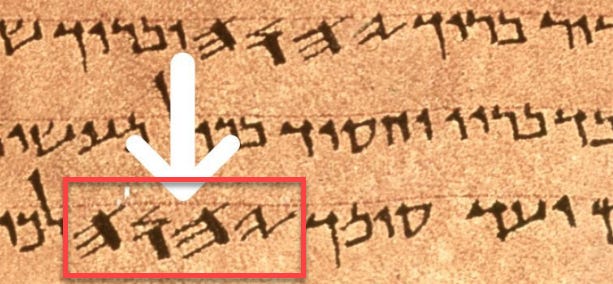
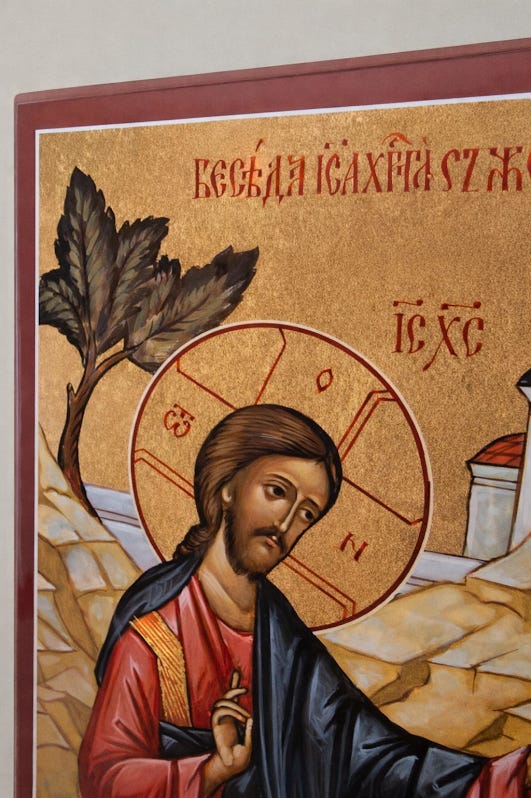
We also see the use of abbreviation in the psalms (e.g., Ps 67/68 “His name is YH!”). This continues seamlessly into later Orthodox iconography, where Christ’s halo still bears “ὁ ὢν” — “the One Who Is.” (the Christian form of the Hebrew I AM).
Let me conclude with an invitation, if you want to get a sense of how the early Christians worshiped in the Megiddo church in A.D. 230, visit a traditional Eastern Orthodox church in a town near you!