
In Northwest Montana this August, we have been dealing with heavy smoke from forest fires to the west of us. I snapped this picture of a fire near Whitefish Lake. The smoke got much worse.
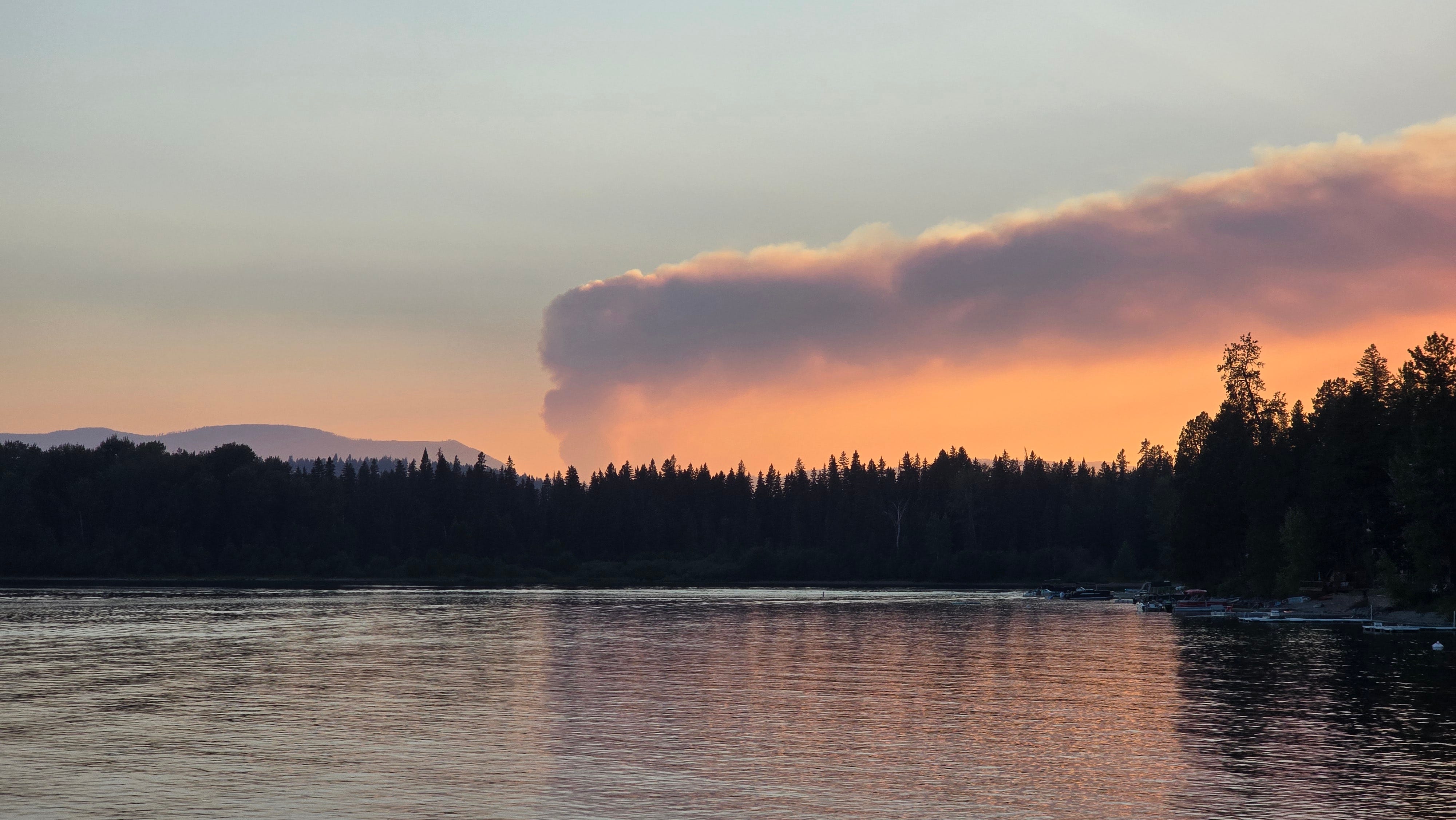
With smoke in my eyes and on my brain, I figured it was a good chance to write about a psalm verse that has been on the back-burner (ha!) for a few years.
Quoting from Brenton's English translation of the Greek Psalter:
Fire, hail, snow, ice, stormy wind; the things that perform his word.
And this from the Hebrew Masoretic Text:
Fire and hail, snow and smoke; stormy wind, doing his word.
So is it ice or smoke? The two nouns are quite far apart! Hard and cold versus soft and hot.
Most translations seem to want to split the baby and translate the word in question “vapors” or “mist” or even “clouds”.
The problem with this approach is that neither the Greek nor Hebrew support those translations. The Greek word κρύσταλλος (krustallos) refers to a hard semi-transparent substance. We get the English word crystal from this word. Nothing smoke-like about rock crystal. The Hebrew word קִיטוֹר (qitor) is uncommon, but the context of Genesis 19:28 makes it clear that קִיטוֹר has nothing to do with cold, hard, translucent matter:
“And he looked down toward Sodom and Gomor'rah and toward all the land of the valley, and beheld, and lo, the smoke of the land went up like the smoke of a furnace.” (RSV)
The verb form of קִיטוֹר appears over a hundred times and always refers to burning — nothing at all to do with ice.
There doesn't seem to be any semantic wiggle room on either the Greek or Hebrew side. I therefore conclude that the Hebrew text used by the Septuagint translator didn't contain the Hebrew word קִיטוֹר. Most likely, that text had the common word for ice קרח.
Keeping in mind that ancient Hebrew manuscripts had no vowels, we observe that the two root words share two of three consonants:
קרח (ice)
קטר (smoke)
The letters qof (ק) and resh ( ר) appear in both words and in the same order. The difference is with the third root letter. Ice ends with the letter Het (ח) whereas smoke contains the letter Tet (ט) in the second position.
Now let's look at these two words using an older Hebrew script, one in use before the 3rd century B.C..
Modern. Imperial Aramaic. Paleo.
Het 𐤇 𐡇 ח
Tet 𐤈 𐡈 ט
Notice that the paleo Hebrew forms of theses two letters share distinctive features. One looks like a ladder (Het) and the other like a hot-cross bun (Tet). Both involve several strokes. The strokes are contra-directional. When written by a computer they are easy to tell apart. But scribes were rarely so perfect. In fact, for various reasons, actual written examples of the letter Tet vary widely and can have more resemblance to the letter Het then the Unicode letter Tet.
Here is a link to an academic treatment that shows the variation in scribal representation of the letter Tet: The Origin of the Tet Symbol
What I am suggesting is that at some point along the scribal transmission line, the letter Tet was confused for Het, and in parallel transposed with the Resh and voila, קטר became קרח. The opposite is also possible: Het was mistaken for Tet. Can we tell from the context which direction the change may have gone?
If we consider the art of Hebrew poetry, we can see in this verse — and the first line of the verse that follows — the appearance of simple chiasm and parallelism working together.
Fire, hail, snow, smoke
Hot, cold, cold, hot (chiasm)
Intense, intense, muted, muted (parallelism)
Similarly in the next verse we read:
Mountains and all hills, fruit trees and all cedars
Tall, less tall, less tall, tall (chiasm)
Land, land, plant, plant (parallelism)
This seems intentional to me, but perhaps I am seeing things that are not there. It happens.
Now whether we read the word as smoke or ice does not really make a change to the gist of the psalm, since each idea is a repetition of some preceding word. There is a bigger variant between the Greek text of this psalm and the Hebrew (an entire line) and I will address that in my next post.
Given the frequency with which I post, the fires in this part of the world will almost certainly be gone. 🙏
🔥🧊❄️💨